The Wandering Isles: Session 84
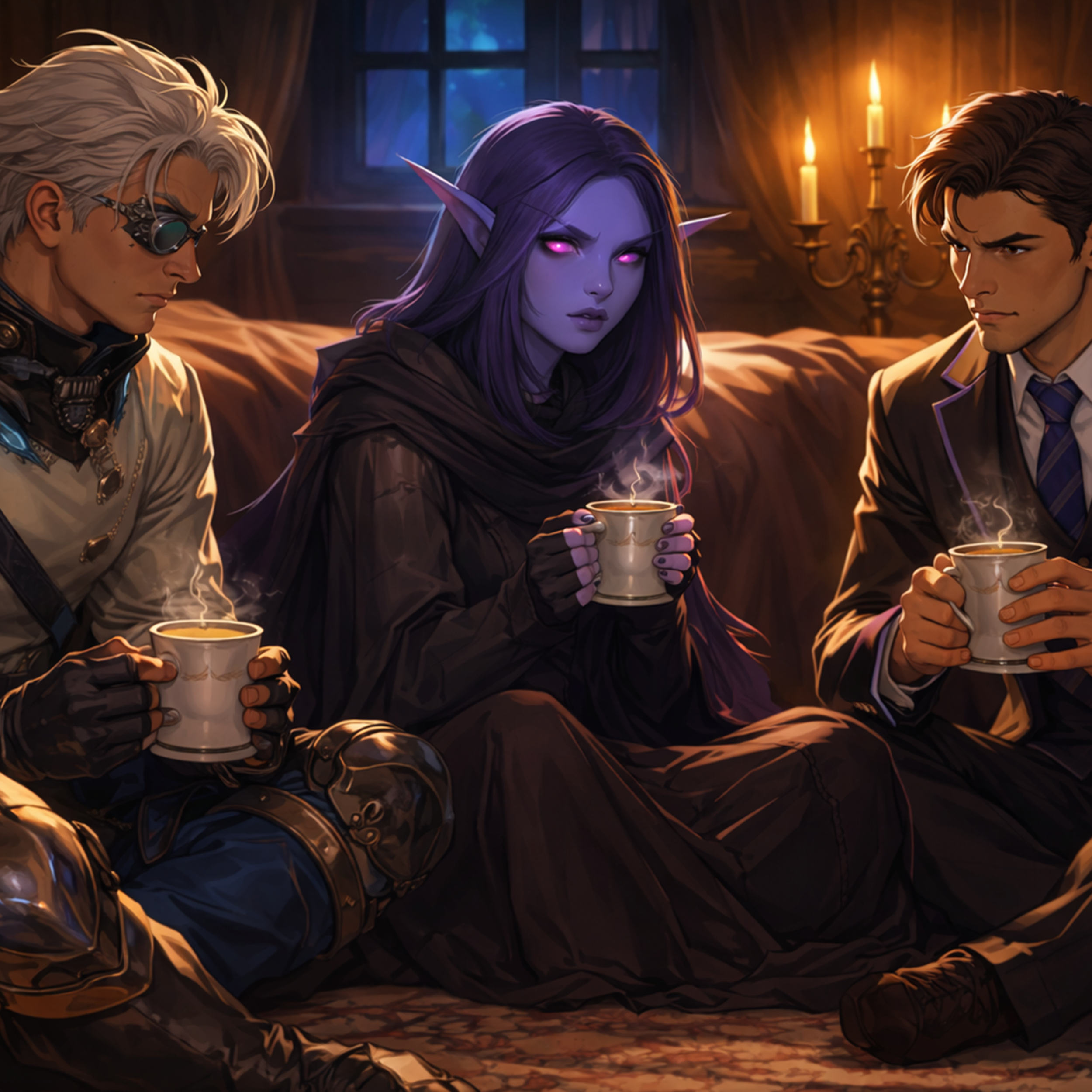
The day in Anbudon starts with someone doing what they always do when the group risks drifting, Weslyn goes to collect Hatsu and pull him off the ship and back toward the others. The walk to the tavern turns into one of those conversations that sounds half like philosophy and half like a warning.
Hatsu, still behind his mask, admits something he does not usually say out loud, that under it, he might just be a monster. Weslyn doesn’t blink at that. To him, most things fall into three neat categories anyway, human, witch, or monster. It is blunt, but it is honest, and in a city like this, honesty at least gives you something firm to stand on.
Weslyn has another problem, a simple one that feels big anyway, he needs clothing. New pants. A shirt. Something that doesn’t make him look like a strange relic walking through an industrial port city. Then Hatsu learns why Weslyn has been standing out even more than usual, Dash has been holding all of Weslyn’s money. Hatsu’s suspicion snaps into place fast. To him, it looks like Dash took advantage of Weslyn’s softness.
Before that can turn into a real fracture, an old man wanders over, drawn in by the kindness at the table like a moth to flame. He sees Weslyn’s generosity immediately, and in a gesture that looks righteous on the surface, he “returns” Weslyn’s money, placing it back in his hands as if he’s fixing an injustice. Then he sits down, makes himself comfortable, and eats with them like he belonged there all along.
Eos, not interested in being noticed, uses magic to disguise herself, reshaping into a “normal” human face for the city. Dash, meanwhile, is boiling. He can see the scam for what it is, a random act of kindness that is not kindness at all, just a man taking advantage of Weslyn’s open heart and doing it with a smile.
It gets worse, and funnier, when the old man introduces himself. His name is also Dash. The coincidences pile up in a way that feels almost cosmic. Two Dashes, both with mothers who are tailors. Two Dashes, both with last names starting with H. Weslyn, delighted by the symmetry and trusting by nature, gives the old man three Aurums, a handsome sum in Anbudon, the kind of money most people do not casually hand away. Dash Heidmann’s patience thins to a thread.
Still trying to move his own urgent timeline forward, Weslyn starts asking around about “law readers,” people who can interpret “the stone.” The city gives him nothing. Most locals assume he is simply asking for a lawyer, and the conversations go nowhere. So Weslyn does what he tends to do when faced with a closed door, he tries to turn it into an open one. He invites the old man Dash to join them on their ship and leads him out into the street as if this is how new allies are found.
Back at the table, Hatsu finally confronts Dash Heidmann directly about the money. Why was he keeping Weslyn’s coin pouch at all? Dash insists he was helping, that he holds money because he uses it to help others, that he doesn’t need it, that what he wants is to protect, to give, to keep people alive. Hatsu hears the intention, but the issue isn’t intention. It is control. It is trust. It is what happens when one person decides what is best for another without asking.
While that tension simmers, Amaedrianna moves separately, slipping back down into the hidden space beneath the tavern and meeting Lucien Vale again, the same shadowy broker who speaks like the city itself. This time, he lays his wants bare.
He will fill their ship with supplies. He will line pockets with coins. He will make The Rising Pearl viable.
In exchange, they perform a heist.
Not a slaughter. Not chaos. A museum job. Clean, contained, and deadly serious. The target is oddly specific, a delicate, decorative egg.
Before Amaedrianna pulls the others into it, Dash sets a rule for the city. In places like this, names are weight, and weight draws eyes. He tells them that in “less than reputable places,” they should only refer to Hatsu as “Oni.”
Amaedrianna then brings Eldrin, Eos, and Hatsu into Vale’s presence so the four of them can hear the plan first-hand, while Dash, Weslyn, and the other Dash roam the streets shopping and arguing about nonsense.
Vale explains what the egg is, and why it matters. It was made with gems pulled from the Vlose mines, crafted roughly 1300 to 1400 years ago, then passed down through a family line until it was stolen during the Greenward Rebellion. A relic turned trophy, a piece of history locked behind wealth and glass.
Out in the city, Weslyn walks with both Dashes and tries to sense what legacy Anbudon even has beneath its soot and steam. The old man doesn’t offer much. Mostly he offers presence. Weslyn at least accomplishes something concrete, he finally buys clothes, Victorian-styled, almost like a newsboy’s outfit, something that lets him blend in rather than announce himself.
Dash Heidmann breaks away to cross the street into Cogsley’s Timepieces, searching for any connection to the untouchable family Vale warned them about. Inside, he speaks to Albert Pennyworth, who has run the store for thirty years. Through him, Dash learns the name that matters, Aron Cogsworth, and where he can likely be found, Cogsworth Mechanisms.
When Dash steps back outside, he finds Weslyn and old Dash in the middle of an infuriating conversation, trying to understand how ice cream is made. It is absurd. It is harmless. It is also exactly the sort of distraction that makes Dash feel like he is surrounded by people who do not understand the cliff they are walking along.
Amaedrianna’s patience snaps in a different way. She discovers, accidentally, that old Dash used to be a guard at the very museum she has just been hired to rob. The irony would be perfect if it weren’t so irritating. She finds him so frustrating she considers throwing away the entire connection just to be rid of him. Instead, she sends him away and tries to pull everyone back into alignment so they can think clearly.
While they regroup outside the tavern, Eldrin, Eos, and Hatsu fall into their own conversation. Eos, trying to be careful, asks whether Amaedrianna referred to him as Hatsu or Oni, but she says the name out loud. Hatsu’s reaction is immediate and sharp. He reminds her, heavily, not to say it. Not here. Not ever when eyes might be on them. Eos walks away, upset.
Eldrin tries to step between the edges, explaining to Hatsu that even if the intention is practical, his delivery can come across as rude. Hatsu doubles down. It is not rude, he insists, it is just words. But the more he explains himself, the more heated he becomes, and the more his urgency spills out as sharpness.
Then the truth underneath it surfaces.
He saw his city destroyed. He saw his father die. And now he cannot afford “small mistakes,” because small mistakes compound. Names have weight. Carelessness can ripple outward beyond them, back to families, friends, to the people who will pay for their failure. He is not simply being strict. He is terrified of what happens if they slip.
Eldrin meets him there, not with argument, but with empathy. He acknowledges the grief, the pain, the way trauma sharpens everything into threat. Hatsu calms, at least enough to hear Eldrin. He admits it feels like something is always dragging the group apart. Eldrin agrees, he has felt that since the day he met them. And he says what he wants plainly, for them to become something that holds together. A gel. A bond that keeps them from splitting, so they can save as many people as possible.
Hatsu suggests an important meeting, a realignment, responsibilities, path forward, clarity.
Night falls as they reach the inn Vale arranged for them, The Forest’s Embrace. The entire third floor is theirs, empty, reserved, a rare kind of safety in a city built on watching. But the moment they step inside, it’s obvious Eos is hurting. She drops her disguise, retreats to her room, and shuts the door.
Dash and Eldrin bring her tea and ask what’s wrong. Eos explains simply that Hatsu insulted her. She takes pride in her knowledge, and what was said cut deeper than she expected. Dash tries to mediate, but struggles to track exactly what landed wrong. Eldrin steps in and translates the emotional shape of it, then tells them about Hatsu’s idea for a meeting. He reminds them all they have not had time to process anything, not Saigo no Toshi, not the siege, not grief, not survival, not the fact that Hatsu lost his father and kept moving anyway.
Eos accepts that. She says she will apologize, if she can find the right apology.
The conversation softens. Eldrin mentions, almost in passing, that back at The Rising Pearl he prayed. He asked his god for the island to be safe, and for the land to have what it needed to grow and prosper. And the island sprouted with trees. The land was saved. Dash, half joking and half serious, says he needs to start praying too if those are the results. Eos asks which god. Dash answers, “all of them.”
Eldrin and Dash also admit they left twelve Aurums in the temple here. Dash then confesses something older, that he robbed someone for two hundred Aurums months ago, and poured much of it into Asazaki, Eos’s home village. The shape of Dash’s morality is complicated, but it is consistent. He steals from one place and tries to heal another.
To change the subject, Dash asks Eos what her favorite spell is. She struggles to choose. She likes making water. She likes shooting lightning.
Then Eldrin admits something that scares him. He did something to Amaedrianna, something he has never done before. He created angry energy with his hands and it hurt her, covered her in wounds. He didn’t mean to. He didn’t understand it. He is ashamed of it. Dash, ever practical, suggests sparring, that Eldrin should spar with him, learn control through contact. Eldrin refuses.
Soon after, everyone gathers in the inn’s main hall. Amaedrianna asks if they should discuss events now.
Eos steps forward first. She shuffles toward Hatsu, bows, and apologizes for misspeaking. She offers friendship and respect. Hatsu bows back and shakes her hand firmly at the wrist. He tells her it’s not a big deal, but repeats the warning, be careful. The people who killed his father would use information against them. They would go after her mother. He reinforces that he respects her knowledge, but he fears failure because people depend on their success.
With that tension eased, Amaedrianna takes the floor.
She lays out the reality, she has secured access to one hundred tonnes of building materials, tools, seeds, food, medicine, everything The Rising Pearl needs to become a real settlement. At market rates, it would cost four to five hundred Aurums, possibly double. They cannot afford it.
But she was offered a job. A job that would cover the cost.
And she is asking her friends, the people she trusts most, to help her do it, not for her pride, but for the people they swore to protect.
She explains the egg again, stolen during the rebellion meant to stop industrialization. Dash asks if it was the Greenward Rebellion, and she confirms it. Eldrin confirms it too. Amaedrianna says the item is being held hostage by money and power in a museum vault. She doesn’t know who it will go to if they steal it, and that uncertainty bothers her. But letting down the refugees bothers her more.
Dash pivots immediately to logistics. When do they move it? Amaedrianna says it is only brought out for dignitaries and royalty. Dash mentions he overheard talk that a convoy from the King may arrive. That could be the perfect moment, either to strike or at least to learn the object’s movements. Eos urges subtlety. Dash agrees, if they are planning to move it anyway, watching the process could reveal everything they need.
Amaedrianna asks the two questions that matter. Who abstains, and who helps? Then, when do they strike, now while things are quiet, or later when the convoy creates chaos and opportunity?
Hatsu warns Dash that his usual “blend into the crowd” methods get harder when you have a ship full of precious cargo waiting to become an anchor around your neck. If something goes wrong, they need to flee, and the ship is not even loaded yet. Dash agrees, timing matters. Hatsu adds that bored guards on a dull night can be their own opportunity.
Eos suggests a switch, if the egg is gem-formed, could they make a replica and replace it? Amaedrianna confirms it is possible. Dash hesitates at the thought of commissions and loose threads, but admits it may be worth considering.
Dash starts pulling at deeper strings. Who funds the museum? Is it privately owned? Who pays the guards? Are they outsourced? He wonders if this ties into the Cogsworth family he just brushed against. Amaedrianna warns him those threads lead back to him if it fails. Dash counters that those threads might also become an alibi. Amaedrianna agrees.
Eos brings up Mirelle Vaudrelle, the “perfume lady” in Palperroth who works with glass bottles, maybe she has a connection they can exploit. Dash says it would take too long, but he did security consulting work for her, and that kind of experience might apply here. Amaedrianna points out that being a consultant on the night something is stolen is a special kind of foolish.
She wants recon as soon as possible. Tonight, she just wants to know who is in.
Everyone says yes. No hesitation.
Amaedrianna then asks something unique of Weslyn, whether he can use dreams to implant false thoughts or memories, put a face in a guard’s mind, twist perception in their favor. Weslyn says it likely doesn’t work that way.
Then Weslyn finally pushes back hard. He asks how many coins Dash was given from him. Could that have paid for supplies? The group says no, it wasn’t enough. Weslyn says the group should know better. Stealing is wrong.
Hatsu argues they would be returning it to who it belongs to, since it was stolen in the first place. Weslyn refuses to budge. He says he will help peripherally, but not directly. Not to steal.
Eos, trying to contribute an angle, suggests using the orphans as a distraction, since Eldrin and Dash donated to them. Dash quickly shuts that down with a quiet reminder that they didn’t buy children. Eldrin makes it firm, he will not put children in harm’s way.
Hatsu suggests another tactic, a gala hosted by their benefactor cleric, a way to gather information and build an alibi. Amaedrianna prefers it clandestine, but Hatsu repeats that an alibi is protection, and protection keeps them alive.
Weslyn asks what happens if they fail. Amaedrianna answers plainly, whoever is caught is probably hung in the town square.
Weslyn reminds them he has an obligation here, and they cannot just flee with valuable items without considering the consequences. Dash estimates planning will take about ten days. Weslyn says his meeting is in eight days, he will meet Delphini Urging here then.
Weslyn asks what the object truly is. Amaedrianna calls it a piece of history the wealthy control instead of returning to the people. Dash asks when she has to hand it over and whether they can spare even ten minutes to investigate it once they have it. Eos shrugs, “it’s just a shiny egg,” but Dash isn’t convinced. Why hold it hostage if it isn’t powerful, or magical? Why hide it instead of flaunting it?
Eldrin says they do flaunt it, just behind closed doors.
Weslyn suggests the simplest route, why not just ask to see it? Dash admits he doesn’t know how to do that. Weslyn reminds him that is literally Dash’s wheelhouse.
Eos advises that when they scout the museum, they should use different paths and distractions to avoid drawing attention. Dash calls it for the night and says they begin after breakfast.
Weslyn still looks sick with the idea. He says it feels wrong, that some things aren’t worth chasing. Hatsu answers with the truth they cannot dodge, they have no alternative. Supplies are expensive. Time is short. They need more than they can afford.
Weslyn says they could try anything but robbery, and yet they keep leaning into theft. Hatsu asks what Weslyn’s “master” wants, if not stealing. Weslyn says knowledge, a stone. Dash points out this egg is a stone too, in its own way.
Weslyn repeats his boundary, stealing is wrong, and he will not steal. Dash reminds him he offered peripheral support. Weslyn agrees. He’ll do what he can.
And with that, the group finally lets the night take them.
In the morning, the preparation begins.