The Wandering Isles: Session 90
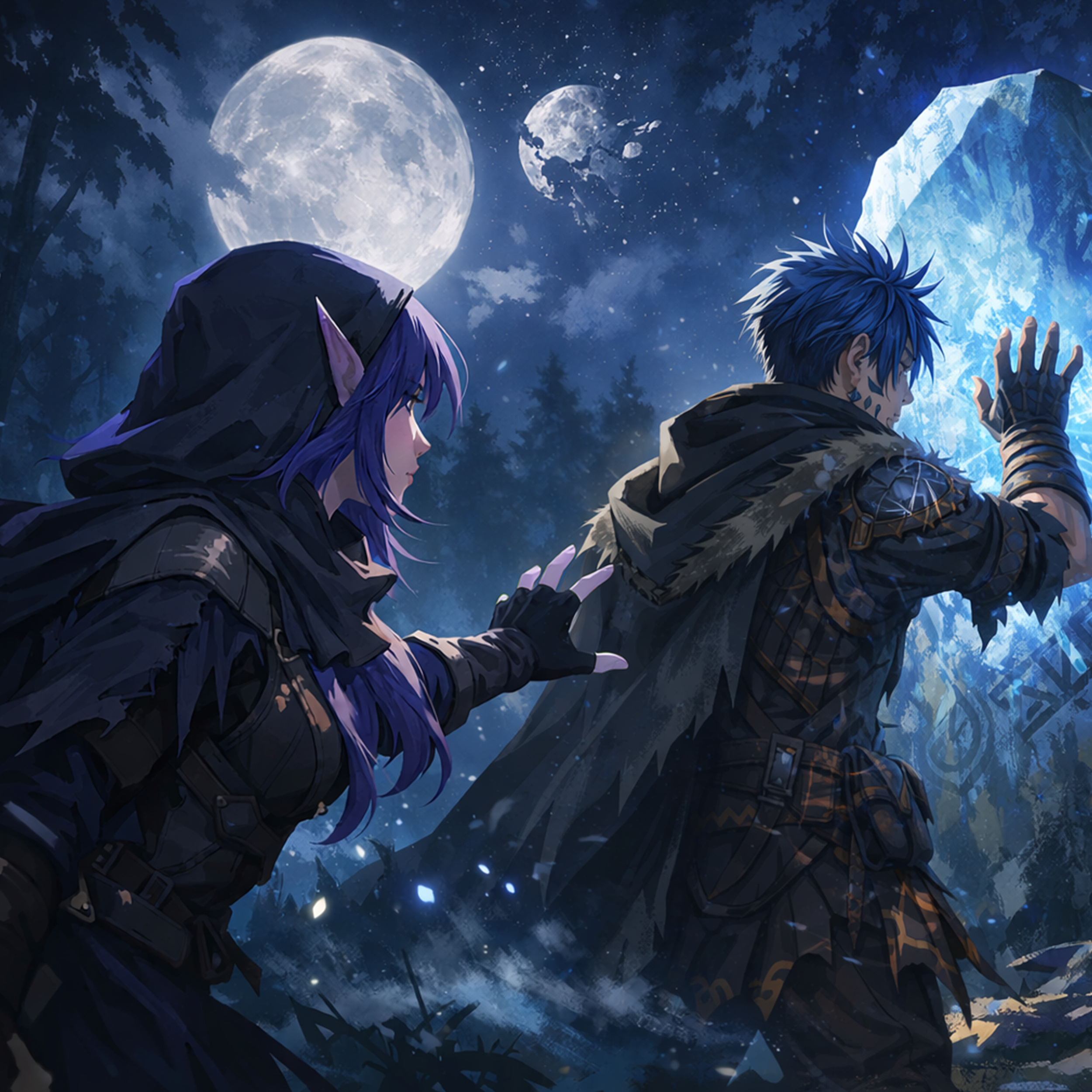
Eos and Ekdíkisi
Eos found herself alone in the forest, chasing after Ekdíkisi beneath dark moons hanging high overhead. They had once been two minds sharing one body; now they inhabited separate bodies. The woods did not welcome her. She tried to soothe them anyway, first by using magic to mimic the caw of a raven, then by slipping down from Duckie’s back and offering peace in a gentler form. She pulled water from the path itself and fed it to the plants around her, a quiet gesture of apology to a place that seemed to resent her presence. But the forest answered in its own way. She saw eyes in the dark. She heard ringing. When she called out, asking where “she” was, the word “witch” came back to her through the trees. A warning pounded at the edges of her mind as the bells continued to ring, and then a dark voice spoke, asking for knowledge. Eos answered as honestly as she could, saying she was from another time, another place. The voice asked whether they were both destined for boats. She took it as almost a compliment, never quite catching the deeper cruelty in the implication. The voice called her innocent, then gave her an hour. Find her, or do not.
So Eos mounted Duckie and pressed on until she found Ekdíkisi at last. Not in light, but in fire. The woods were lit by sparks drifting like fireflies, but there was no sound to them. When Eos dismounted, even that simple act made no noise. She could feel the heat. She could feel touch. But all she heard was ringing, ticking like a clock, and the strained creaking of the trees. Ekdíkisi struck her with magic and demanded to know why she was being followed. Around them, the forest burned as Ekdíkisi searched for something unseen, something she seemed close to finding. Then came the chilling promise: “If I’m correct, I won’t need you anymore.” When Eos asked what this place was, what this meant, Ekdíkisi gave her no comfort. This was not a dream, she said. This was reality. Then she opened a portal and told Eos she could keep the life she had been given, but that she would be back for what was hers. And with that, she stepped through and vanished.
Eos returned in a fury, riding back and teleporting to the house with the smell of ash still clinging to her. Inside, the mood had already begun to turn inward. Hatsu Toshitsugu sat among the impossible gathering at the table and found himself struck by memories of Saigo no Toshi before the fall—his home, his city, his people, and the feeling of simply being among them before grief had carved him into someone else. It reminded him too of his younger sister Asuka, and the urgency she had always carried, the way she acted when things needed doing. He sat with that thought in silence until the sound of a horse broke through it.
Conversations at the house
Outside, Dash Heidmann and Amaedrianna Blüdfist had slipped away for a quieter conversation. Dash sat beside her while she held Elysa and he cradled Ash. Elysa, golden-skinned and golden-eyed, drew an immediate dry remark from Amaedrianna, who noted that the child was cute, all things considered, given that she had come from Dash. He let that pass and went straight to the point, asking why she had lost control earlier—why she had smashed chairs and screamed into the void when that kind of unraveling was so unlike her. Amaedrianna answered more plainly than usual, stripped of her colder edge as she played with the baby in her arms. She said she had spent years with no control at all, had finally clawed some of it back, and now suddenly felt as though it was slipping through her fingers again. Dash had his children and Lysa. Eldrin had his parents. Weslyn had his mother. Hatsu had his family. Even Eos, she observed, had someone who meant something to her. But her? She did not know whether she meant nobody to anyone, or whether nobody meant anything to her. Dash tried to reassure her, but she brushed it aside with the sharp practicality that he had always been there already. That mattered, and she appreciated it, but it did not ease what frightened her. So Dash offered her something more concrete: the role of godmother to his children. He could not think of anyone better to protect them. Amaedrianna sat with that, then declined the title itself while still promising that nothing would happen to them. Then, with a flicker of humor, she asked why he could not think of her as more of a fairy godmother instead.
That was when they smelled the burning. A moment later Eos appeared, teleporting in with mud on her boots and the reek of embers on her, visibly furious. Amaedrianna asked, with immediate suspicion, whether she had been burning trees, and Eos recounted what had happened in the forest. The story ended in two blunt words: “She’s gone.” Then, stripped raw by everything that had just occurred, she added that she wanted to go home.
The others gathered around that pain quickly. Hatsu asked why she had been there at all, where exactly she had gone. Eos explained she had been searching for the portal. He clarified the real question: when had Ekdíkisi ended up inside her mind? Eos answered that it had happened the day she died. That answer reframed everything. Hatsu and Amaedrianna both pointed out the implication—if Ekdíkisi no longer needed her, then she was gone now. Eos panicked at that and insisted that she did still need her, but the group pushed back gently. They reminded her how powerful she was. They all did. Again and again the same truth surfaced: Ekdíkisi had needed Eos, not the other way around.
Offerings in the forest
As Eos explained what she had told the voice in the forest, including that she had spoken of the others, Weslyn’s concern turned sharply toward the burning woods themselves. He called for his mother, and Isolde answered with a strange calm, saying the woods could care for themselves. Then came the awful realization: Remington was still out there. Before anyone else could move, Amaedrianna launched herself into action. Seeing streaks of light in the forest, she flew out and found Remington fighting Virethorn, a massive treant-like being of impossible size bearing down on him. She landed beside him and tried to intervene, but Remington did not waste time on explanations. He simply told her to flee. With the Halo harness secured, Amaedrianna shot straight upward, barely avoiding Virethorn’s reach as a boulder nearly slammed into her from behind. She made it back to the group and explained what she had seen. Remington himself did not seem certain what had gone wrong, but Amaedrianna was shaken and immediately feared the creature might come for them.
Weslyn turned on Remington and demanded to know what he had done. Remington explained that he had left the offerings by a tree. Weslyn’s response was immediate: that was not how it was done. Bring them. Remington, to his credit, did not hide behind ignorance. He said he had meant no harm, but accepted responsibility. Eos, already burdened by guilt, insisted it was her fault and recounted her own actions in the forest again. Weslyn pressed harder, asking how long they had been together and whether he had misled them somehow. Remington fully took the blame and offered to make it right however Weslyn saw fit. But when Weslyn said he had put everyone in danger, Amaedrianna snapped back that Weslyn had done that the moment he brought them all here. Weslyn insisted he did not have control, and the argument only broke when Dash’s babies began to cry.
Into that tension came Isolde Theiwyse, Weslyn’s mother and Isolde Thorne’s grandmother, steadying the scene by sheer presence. Eos showed them that Ekdíkisi had somehow bound her using Weslyn’s magic. Weslyn was able to fix it, unraveling what had been done. With that immediate crisis addressed, Isolde urged everyone inside so they could decide their next steps properly.
Bargains and the Rite of Naming
Back indoors, Eos noticed that her staff had changed again. It was no longer a scythe. It had returned to a moon-shaped symbol instead. She asked Isolde whether she knew of Asazaki, but Isolde said plainly that it did not exist yet. The answer carried its own weight. Isolde then turned to Isolde Thorne for clarity on another mystery. Amaedrianna asked where the egg was, but Isolde Theiwyse remained silent. It was Isolde Thorne who answered instead, saying she did not know where it had begun, only where it had gone.
That turned the conversation toward movement, time, and theft. Amaedrianna asked Remington how he had arrived there in the first place. He said Weslyn had brought him, but added that he might know a way out through Dunamancy—the magic of time and space. The group began trying to determine when, exactly, they were, even as Delphini and Weslyn carried on a second conversation in their minds. Delphini confirmed she was willing to use the magical cards he had found and admitted she did not know what the flower had been, only that it was a living, breathing creature. From there the talk circled back to the heist, to the possibility of replicating the egg here in the past, replacing what would be taken later so that the right thing could be stolen at the right moment.
But Amaedrianna’s attention remained fixed on Isolde, and on Weslyn. It was then that Isolde revealed something deeper: Weslyn’s power did not come from her. It came from his father. Weslyn tried to explain what he thought he knew—that he had made a deal with a powerful creature. He started to describe what he believed had been a squirrel. Isolde cut in and said no. It had been Chicken the Fox. That shattered Weslyn’s certainty. He panicked, insisting it had not been Chicken, that it had been a squirrel, that Chicken had never spoken to him. Isolde, however, already knew about the bargain with Chicken and explained that Chicken was not meant to speak. Silence had been part of the deal.
From there, the shape of Weslyn’s past became stranger and more complicated by the minute. The group began to realize he may have made multiple bargains without even understanding it. Weslyn himself came to suspect there might have been three. Isolde clarified as best she could. One deal had belonged to his father, a pact made with the forest. One was Weslyn’s own, made with Chicken. And whatever this squirrel creature was, that seemed to be a third thing entirely. She explained that Weslyn’s father had once made a pact with the forest to protect the family, and that Virethorn had been the emissary who brought that pact to them. She said Weslyn had once followed his father into the woods without bringing an offering. When the forest punished him, he had gone with his father and walked beside him for many years. Weslyn remembered none of it. Isolde continued anyway, saying that he and his father eventually lost each other on that path. His father had kept returning home, searching for him. Weslyn, meanwhile, had simply never come back.
That revelation left Weslyn shaken enough to focus on something practical. He asked where the stone containing the Rite of Naming was. Isolde said it was with the new Law Speaker. Dash was the one who connected the pieces aloud. In Palperroth, names had to be approved by the king. The Rite of Naming, then, was in the throne itself.
Questions spread around the table from there. Wilheim Drosk, Eldrin’s father, wanted to know how much any of them would remember when this was over. Weslyn answered that it depended on how well one remembered a dream. Hatsu went back over how they had arrived there in the first place, trying to reverse engineer the logic of their journey. Delphini contributed the crucial detail that they were likely tethered by the marks on their wrists. She herself had no mark, because she had reached this place through a wish—a fact she was not pleased about.
A conversation with Chicken
Then Weslyn turned to older, stranger methods. Speaking in a forbidden tongue, he cast a spell to speak with animals. To everyone’s surprise, Chicken remained silent. Duckie did not. The horse practically exploded with relief, finally able to speak, immediately demanding to know why Eos had been allowed into the forest and insisting, with tremendous passion, that he hated sugar. Weslyn dutifully relayed the message. Eos, meanwhile, was left confused by the whole thing, especially the idea that Chicken might somehow understand that old tongue. The conversation widened again when it came up that Amaedrianna could also speak it, though she did not know why. Duckie, undeterred by any of this, continued talking and took time to mention that Dash had actually taken very good care of him. Chicken, disappointingly, said nothing.
So Weslyn tried a different approach. Through telepathy, he reached toward Chicken directly and spoke with painful honesty. He admitted that his mind was full of holes, that he had to believe someone, and that right then Chicken might be the only one in the middle of all this that he could trust. Chicken did not answer in words. Instead, the fox stood up, pressed in close, and nudged Weslyn’s cheek. When Weslyn asked whether they should go home, Chicken’s answer was action rather than speech. The fox went to the door.
That became enough. Isolde told Weslyn she was proud of him, then asked whether he had a message for his father. He said he was sorry. She answered simply: he knows. Weslyn asked whether his father could make the boat that would send him out into the world when the time came. Isolde said a boat would be waiting, one marked in a way only he would understand. It would bear the words, “Be warned those deemed as a witch, this is the fate that serves.” And in that moment Weslyn realized he knew that boat already. He had seen it in a museum in the future.
The conclusion came to him hard and fast. He looked at Dash and said, “the king has to die and the stone has to return.” Beside all of this, in one of the episode’s stranger but softer notes, Eos sat with elderberry tea and tried to recover while Hatsu continued wrestling with what the next steps had to be.
Leaving the house
At last they set out together: Amaedrianna, Boreal, Dash, Delphini, Eldrin, Eos, Hatsu, and Weslyn. When they looked back, the door was shut, the table was empty, and their families were gone. Then they walked into the woods.
The house faded behind them as if it had always been meant to disappear. Only the group remained now—Amaedrianna, Dash, Delphini, Eldrin, Eos, Hatsu, Weslyn, Zephyr, Duckie, and Boreal. Remington was not with them. Chicken led the way. They carried offerings for the woods: bread, wine, and iron. As they passed through the scorched section of forest, those offerings vanished from their hands. Gifts accepted. Apology acknowledged. Forgiveness uncertain. The ringing returned, joined again by that infernal ticking, and the path ahead felt deeply, terribly familiar. Deja vu pressed in from all sides. No one felt much like speaking. The group kept moving in silence, each of them occupied by the weight of what they had just learned, while for Eos the ringing and ticking only grew stronger.
Reading the Winter Stone
Then the visions came back.
Eos saw a ship in violent storm waters. She saw wolves racing through snow. She saw a cruel, laughing figure. She saw her own face again. Without Ekdíkisi in her mind, the visions no longer came with structure or interpretation. They just swirled through her, raw and unresolved, and she had no way to make sense of them. At last the group came to a stop before a great carved stone in the woods. For some reason only Amaedrianna could read what was written there. Weslyn stepped forward and placed his hand against it, and blue magic rippled outward through the air.
The instant that happened, Eos knew she had seen this moment before. It belonged to the same chain of visions in which she had once seen her father die, and every one of those visions had led to pain, loss, and death. Why should this be any different? Amaedrianna began to read, and what the stone held was not the Rite of Naming at all. It was the tale of the corrupted one, the tale of one who remained nameless, a presence woven through every broken point in the land’s history like a spirit haunting an old house or a voice from deep within the woods.
“In the days when the Kin still bowed to the frozen earth,
there walked those called the Keepers of Silence.
They were of no house,
and bore no mark upon their hands.”
At those words, everyone became sharply aware of the marks upon their own hands. Eos’s pain surged so hard she collapsed, and Dash rushed to her side as Amaedrianna kept reading.
“When the fires guttered,
and the fields slept beneath glass,
they came to the Law Stone.
There they washed it with snowmelt and ash,
and spoke no word as they worked.
They carved no new names,
for all names then were ended.
Their duty was to still the Law,
lest it grow hungry in the long dark.”
As those words were spoken, Eos dropped fully into another vision. She found herself in a vast city of sand and stone, larger and grander than anything she had ever known. It was alive. Children filled its streets and parks. Libraries stood open and full. Learning, culture, life—it all pulsed through the place. It felt real, vibrant, untouched by the rot and corruption that had defined so many of her earlier visions. Then the sky darkened. Not with clouds, but with something alive. A massive winged creature spread itself across the heavens, with an immense wingspan, a long neck, spines, claws, and a tail that looked capable of taking the whole city apart by itself.
The panic in the streets came not from those who had seen it overhead, but from those already running from battle below. Eos saw a robed man with a staff striking people and turning them into Ichor. Others rushed to meet him. A woman appeared first in the shape of a bird, then shifted into human form to heal someone before racing onward. A small man with a heavy mace charged through the chaos, fighting desperately as the city tore itself apart. All the while, the inscription continued.
“When the dying called for witness,
it was the Winter Caste who came.
They did not speak the last word,
but carried it in silence to the Stone.
They bound the names of the dead in linen,
and laid them beneath its face.
So the Law slept with those it had judged.
They whispered into the frost,
‘All things return to silence.’”
Then the great creature descended. It unleashed a devastating purple flame—or something worse than flame—and Eos felt her flesh burn away as the blast consumed the city. In a single catastrophic instant, the place was annihilated. This was the Battle of the Emissaries.
When she returned to herself, disoriented and shaking, Dash was there asking if she was alright. Amaedrianna finished reading the last lines of the stone.
“When the thaw began,
they departed unseen.
None marked their passing,
but each spring the Stone gleamed anew,
its cuts clean, its words whole.
Thus was the Law kept unbroken through death.
Thus is the silence of winter
the breath that returns the world to order.”
By the time the final words faded, both Eos and Weslyn understood that something essential had just been revealed to them. The vision had shown Eos where she had been. The stone had shown Weslyn what he needed to know. And together, at the edge of that forest with the weight of the past pressing in from every side, they realized where they had to go next.